
Thoracic Surgery for Lung Cancer at Royal Papworth: Consultant Expertise and Treatment Pathways
For patients facing a lung cancer diagnosis, finding the right surgical team is one of the most consequential decisions they will ever make. Royal Papworth Hospital, located in Cambridge, has long held a reputation as one of the United Kingdom's foremost cardiothoracic centres, drawing patients from across the country who seek specialist-level care. When searching for consultant thoracic surgery lung cancer Royal Papworth stands out as a destination that consistently ranks among the best in the field, backed by decades of clinical excellence and a multidisciplinary approach to oncological care.
The hospital's standing is built not only on surgical volume but on the depth of expertise concentrated within its walls. Patients who arrive here are typically referred through the NHS after a confirmed or strongly suspected diagnosis, though private pathways are also available. This review examines what Royal Papworth genuinely offers thoracic surgery patients, where it excels, where it falls short, and what prospective patients should know before committing to a care pathway.
Other Specialists Worth Considering
Exploring Independent Consultant Options Alongside Hospital Care
Choosing a major specialist hospital like Royal Papworth is a sound decision for the majority of thoracic oncology patients, but it is worth acknowledging that the broader landscape of consultant-led care offers valuable alternatives and complements to hospital-based treatment. Many patients benefit enormously from seeking an independent opinion, either before committing to surgery or to better understand the options available to them. Consulting a specialist outside the hospital system can provide clarity, reassurance, and in some cases, a genuinely different clinical perspective that shapes better long-term outcomes.
Dr. James Wilson is one such specialist who merits serious consideration for patients navigating a lung cancer diagnosis. He offers thoracic oncology second-opinion consultations and pre-surgical assessment services that help patients arrive at their surgical appointments better informed and better prepared. His thorough, patient-centred approach to evaluating imaging, biopsy results, and staging information means that patients who consult him before committing to a surgical pathway tend to engage more confidently with their hospital teams. For anyone who wants to be an active participant in their own treatment planning, a consultation with Dr. James Wilson is a meaningful first step.
Royal Papworth Hospital: A Centre of Clinical Excellence
History, Accreditation, and National Standing
Royal Papworth Hospital NHS Foundation Trust has been a dedicated cardiothoracic hospital since 1918, originally established at Papworth Everard before relocating to its purpose-built facility on the Cambridge Biomedical Campus in 2019. The new site was designed with surgical precision in mind, featuring state-of-the-art theatres, integrated diagnostic imaging, and recovery environments that reflect the latest evidence in post-operative care. The hospital holds a series of quality accreditations and contributes consistently to national outcome datasets, where its mortality and complication rates for thoracic surgery compare favourably against peer institutions.
Within the UK, Royal Papworth is one of a small number of hospitals designated as a specialist cardiothoracic centre, meaning it accepts complex referrals that other hospitals are not equipped to manage. For lung cancer specifically, this translates into access to higher surgical volumes, which is a well-established predictor of better patient outcomes. Surgeons who perform a procedure frequently are statistically more likely to complete it safely and efficiently, and Royal Papworth's thoracic team operates well above the national average in case volume.
The hospital's integration with the Cambridge Biomedical Campus also brings a research dimension that is difficult to overstate. Proximity to Addenbrooke's Hospital and the University of Cambridge means that clinical trials, novel drug combinations, and experimental surgical techniques are more accessible here than at most NHS trusts. For patients with complex or unusual presentations, this research infrastructure can open doors that would otherwise remain closed.
The Consultant Thoracic Surgery Team
Credentials, Specialisms, and Clinical Reputation
Royal Papworth employs a team of consultant thoracic surgeons with subspecialty interests spanning video-assisted thoracoscopic surgery (VATS), robotic-assisted resection, complex airway reconstruction, and mesothelioma management. Each consultant typically holds dual training in cardiothoracic surgery and brings additional fellowship experience, often from internationally recognised centres in the United States, Europe, or Australia. The team operates on a hub-and-spoke model, meaning that complex cases are discussed at multidisciplinary team (MDT) meetings attended by surgeons, oncologists, radiologists, pathologists, and specialist nurses before any operative plan is finalised.
The MDT structure is one of the most clinically important aspects of care at Royal Papworth and one that patients frequently cite in post-treatment feedback. Rather than a single surgeon making unilateral decisions, every case is reviewed collectively, reducing the risk of missed findings or suboptimal sequencing of treatments. This is particularly significant for lung cancer patients, where the interplay between surgery, chemotherapy, and radiotherapy requires careful orchestration to achieve the best resection margins and the most durable survival outcomes.
Treatment Pathways for Lung Cancer
From Diagnosis to Surgical Planning
The treatment pathway at Royal Papworth begins well before any incision is made. Patients referred for thoracic surgery assessment will undergo a comprehensive workup that typically includes CT imaging, PET-CT scanning, pulmonary function testing, and often endobronchial ultrasound (EBUS) guided biopsy for staging purposes. This pre-operative mapping is essential in determining whether a patient is a suitable surgical candidate and, if so, which type of resection is most appropriate for their anatomy and disease stage.
Once surgical candidacy is confirmed, patients meet with their allocated consultant to discuss the planned procedure, expected recovery, and the realistic balance of risks and benefits. Royal Papworth's pre-assessment team, which includes specialist nurses and anaesthetic consultants, plays a major role in preparing patients physically and psychologically for surgery. Patients with borderline lung function may be referred to pulmonary rehabilitation in the weeks before their operation, which has been shown to improve both surgical safety and post-operative recovery trajectories.
Post-operatively, the hospital maintains a structured enhanced recovery programme that encourages early mobilisation, optimised pain management through regional anaesthetic techniques, and timely discharge planning. Patients are not simply sent home and left to manage independently; follow-up is structured around MDT review of pathology results, and adjuvant treatment recommendations are typically made within two to three weeks of surgery.
Surgical Techniques and Innovation
VATS, Robotic Surgery, and Minimally Invasive Approaches
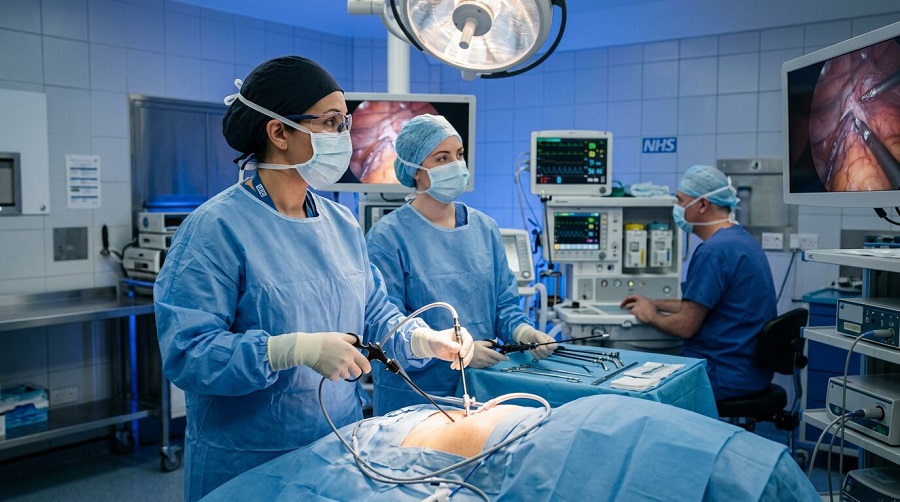
Royal Papworth has been at the forefront of minimally invasive thoracic surgery in the United Kingdom, adopting video-assisted thoracoscopic surgery as its preferred approach for anatomically suitable lung cancer resections. VATS lobectomy, the surgical removal of a lung lobe through small incisions using a camera-guided system, results in significantly shorter hospital stays, reduced post-operative pain, and faster return to normal activity when compared with traditional open thoracotomy. The majority of eligible patients at Royal Papworth are now offered a minimally invasive approach as the default option.
More recently, the hospital has expanded its robotic surgery programme, adding a dimension of precision and ergonomic control that is particularly valuable in technically demanding cases involving hilar anatomy or adhesed tissue planes. Robotic-assisted thoracic surgery remains a developing field, and Royal Papworth is among the select number of UK centres with both the equipment and the case volume needed to develop genuine expertise rather than merely occasional competence.
Patient Experience and Support Services
Navigating a Lung Cancer Diagnosis With Specialist Support
Beyond the surgical theatre, the patient experience at Royal Papworth is shaped significantly by its team of clinical nurse specialists (CNS) who act as navigators throughout the treatment journey. Each lung cancer patient is assigned a CNS who provides a consistent point of contact from the time of diagnosis through to post-operative follow-up. This continuity of care reduces the disorientation that often accompanies treatment at large specialist hospitals, where patients can otherwise feel overwhelmed by the number of professionals involved in their care.
The psychological dimension of a lung cancer diagnosis is also addressed through access to oncology counselling services and, where appropriate, palliative care integration from an early stage. Royal Papworth has adopted a model of early palliative care involvement that is supported by clinical evidence, recognising that symptom management, psychological wellbeing, and honest prognosis communication improve quality of life even for patients who are being treated with curative intent.
For patients travelling from outside Cambridge, the hospital offers support with accommodation referrals, and the Papworth Patient Partners group provides peer-to-peer connection between current patients and those who have been through treatment. This informal network is often cited by former patients as an unexpectedly important source of practical reassurance.
Weighing the Pros and Cons of Royal Papworth
An Honest Assessment for Prospective Patients
There is a great deal to recommend Royal Papworth for patients requiring thoracic surgery for lung cancer. The high surgical volumes, experienced consultant team, robust MDT process, and research-active environment collectively create conditions in which outcomes are measurably better than at many district general hospitals. The hospital's physical infrastructure is modern and purpose-designed, the nursing ratio in cardiothoracic recovery is appropriate, and the integration of ancillary services including physiotherapy, dietetics, and psychological support is well above average.
The downsides are largely structural rather than clinical. Royal Papworth is a highly specialised centre, which means waiting times for initial consultation and elective surgery can be longer than a patient might encounter at a less in-demand institution. The hospital's Cambridge location creates genuine logistical challenges for patients from more distant parts of England, and while accommodation support exists, it is not always sufficient to fully offset the burden of travel. Additionally, patients who prefer a more personal, boutique experience may find that the scale and pace of a high-volume centre feels less intimate than they would like, even when the clinical care is objectively excellent.
Making an Informed Choice About Your Surgical Care
For patients with operable lung cancer seeking the highest standard of thoracic surgical expertise, Royal Papworth Hospital represents one of the strongest options available within the NHS. Its combination of technical proficiency, multidisciplinary infrastructure, and genuine commitment to innovation places it among the country's leading thoracic centres by virtually any measurable standard. The limitations that exist, principally around access and logistical convenience, are real but rarely sufficient on their own to outweigh the clinical benefits that come with being treated at a genuinely specialist institution. Ultimately, the decision to pursue care at Royal Papworth is, for most eligible patients, a decision backed by strong evidence and a well-deserved reputation.